
Smith County Criminal History Checks
The free Smith County Public Access portal is the sound first stop for a local court or jail lead. Its online criminal coverage is reported from 1995 forward. A result can identify a cause number, court, filing date, charge wording, status, events, and disposition. It does not prove that two people with the same name are one person. Start with a full legal name, check spelling variants, and use a birth date or known case number only when the official search permits it.
Move from the index to the custodian. The District Clerk keeps felony files, the County Clerk Criminal Division keeps Class A and B misdemeanor files, and a municipal or justice court keeps many fine-only matters. Current jail custody has its own search. Older or inactive files may sit at Records Services rather than online. A certified judgment must come from the clerk, not from a screen capture of an index.
- Search Public Access for a local case lead and note the cause number, court, dates, charge, and status.
- Identify the correct court level before asking for a file or certified copy.
- Check the county jail application separately when present custody or a recent booking is the question.
- Ask Records Services about a pre-1995 or inactive matter that does not appear online.
- Use Texas DPS for the statewide public conviction and deferred-adjudication subset, or fingerprints to review your own linked Texas record.
The official Smith County gateway shows where local departments and courts publish their routes.
The county gateway is useful when a saved departmental link changes during the courthouse transition.
Three Smith County Criminal Records
A jail entry, court file, and DPS history answer different questions. The jail entry records intake and custody. It may show a booking number, arresting agency, alleged charges, bond, and release status. The court file records what prosecutors filed and what a judge or jury did. It can include an indictment or information, motions, plea, judgment, sentence, and later revocation events. The public DPS product shows the statewide conviction and deferred-adjudication data that Texas law allows for public name searches.
Those sources may disagree without any one of them being false. A booking allegation can be changed before filing. A case can be dismissed after the arrest event was sent to DPS. A disposition may also reach the state repository late. For a sound Smith County record review, save the booking number, cause number, and state tracking identifiers separately. Then use the final court judgment to understand the local outcome.
- Booking number
- The jail's identifier for a custody event.
- Cause number
- The clerk's identifier for a court case.
- TRN
- The tracking number that follows a fingerprinted arrest event through Texas reporting.
- SID
- The Texas state identity number tied to fingerprint data.
Official Background Checks in Texas
The Texas DPS Criminal History Conviction Name Search lets any member of the public search the authorized conviction and deferred-adjudication data. An account and search credits are required. Each search credit costs $1, and a no-match result still uses a credit. Opening more than one candidate consumes more credits. Soundex is the default match method, so similar surnames may appear even when the searcher entered the right spelling.
For a review of your own more complete Texas record, use the fingerprint route described by DPS. FAST appointments are handled through IdentoGO by IDEMIA. DPS lists a $15 personal record-review fee plus a $10 FAST fingerprint fee. The FBI Identity History Summary is a separate fingerprint-based own-record product for federal data. Neither product is the same as a Smith County court-file search.
| Official route | Known cost | Best use |
|---|---|---|
| DPS public CCH | $1 per search credit | Public Texas conviction and deferred-adjudication subset |
| DPS CR-42 mail search | $10 per subject | Mailed public name search |
| Personal DPS review | $15 plus $10 FAST fee | Your own fingerprint-linked Texas record |
The FAST appointment service is the official fingerprint scheduling channel.
Fingerprint comparison resolves identity far better than a name-only candidate list.
Smith County DPS Search Limits
A $1 DPS search is not a complete Texas record. Government Code Section 411.135 authorizes the public slice, while other parts of Chapter 411 keep criminal-history record information confidential unless an exception applies. The public portal can help locate reported convictions and deferred adjudications, yet it cannot replace a personal fingerprint review. DPS states that only fingerprint comparison positively associates a person with a criminal-history record.
The interface asks for first and last name, while middle or maiden name, date of birth, sex, and race can narrow candidates. Users may choose Soundex or exact matching. The preview can show descriptors and may show a photo before a full record is opened. Use a full legal name, avoid nicknames, and compare all lawful identifiers. If the record concerns your own identity and the match stays uncertain, stop guessing and use fingerprints.
| Search field | Required | How it helps |
|---|---|---|
| Last and first name | Yes | Starts a name or Soundex match |
| Middle or maiden name | No | Separates similar candidates |
| Date of birth | No | Allows full, partial, or expanded-date searching |
| Sex and race | No | Narrows results when known |
| TRN or SID | By search type | Uses a known state record identifier |
The DPS search help page sets out credit charges and name-matching cautions.
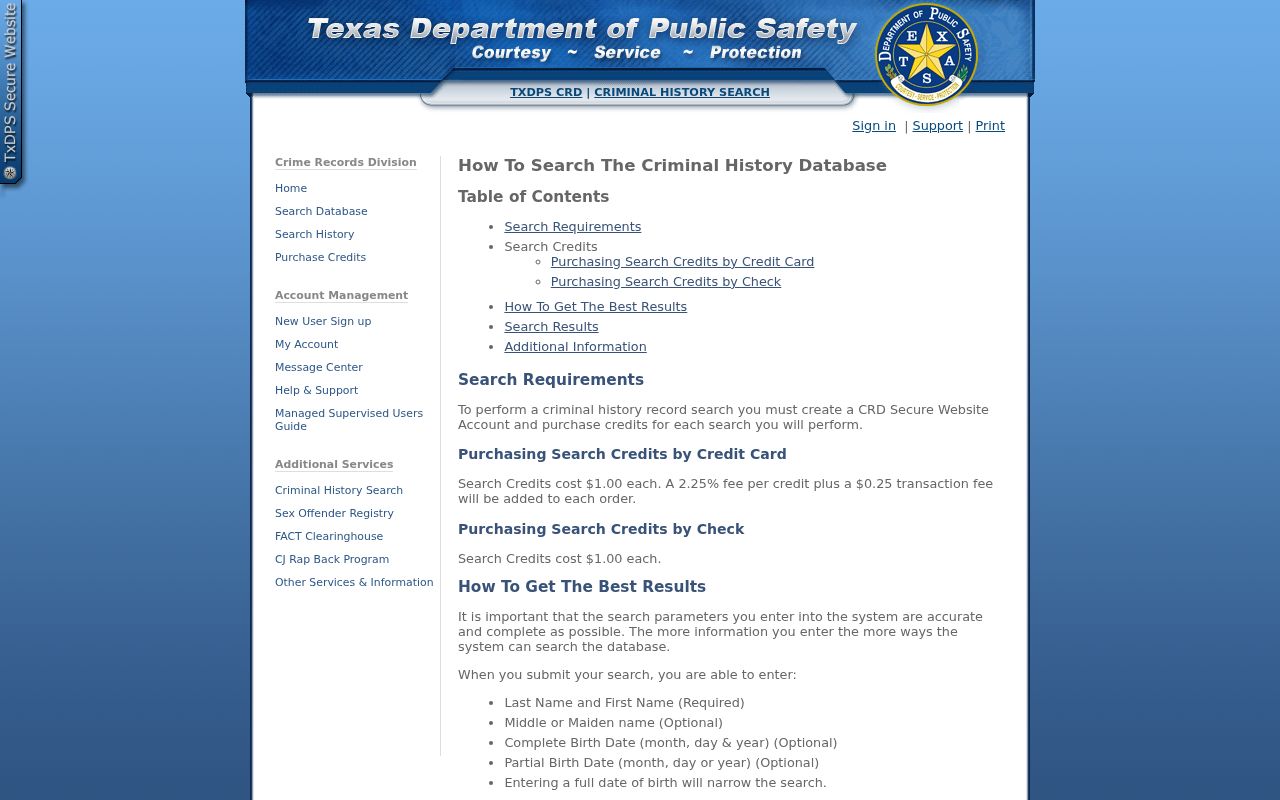
Its limits explain why a county judgment and fingerprint review can still be needed after a public name search.
Kinds of Criminal Records
Smith County criminal records are created at different points. A police or sheriff's incident report describes the reported event and investigation, sometimes without an arrest. An arrest report states the officer's authority and allegations. The jail then makes a booking record with intake and custody details. If prosecutors file a charge, the proper clerk creates the court case file. DPS may connect a fingerprinted arrest cycle with prosecution, court, custody, and supervision reports.
Warrants, probation, parole, and registry entries remain separate as well. No verified complete countywide warrant list was found, so the issuing court and law-enforcement office are the proper fallback. Smith County Community Supervision and Corrections Department handles local adult probation. TDCJ handles state prison and parole information. The Texas registry is a public-safety system under Chapter 62, not a general rap sheet.
- Incident and arrest records: request them from the agency that created them.
- Booking records: use Smith County Jail Search for current custody and request older material.
- Court records: ask the District Clerk, County Clerk, municipal court, or justice court based on the case level.
- State history: use DPS public CCH or the fingerprint route that fits the question.
- Custody and supervision: distinguish the county jail, TDCJ prison, probation, and parole systems.
Smith County Portal Record Cutoff
Smith County reports general online criminal coverage from 1995 forward. The County Clerk's misdemeanor holdings reach back to 1976, while Records Services preserves inactive files, minute books, ledgers, and indexes that can reach much farther into the county's history. A failed web search is therefore weak proof for historical or genealogy work. Supply an approximate year, name, court or offense, and any old cause number when asking staff to trace a file.
Records Services operates in Room 150 in the Cotton Belt Building basement at 1517 West Front Street in Tyler. Its published hours are Monday through Friday, 8 a.m. to 5 p.m., with a noon to 1 p.m. closure. Call 903-590-2960 before a trip when construction or a records move could affect access. A public index is a lead; request the clerk's certified record when proof of a disposition is required.
The Smith County Records Services page explains the archive counter and online coverage.
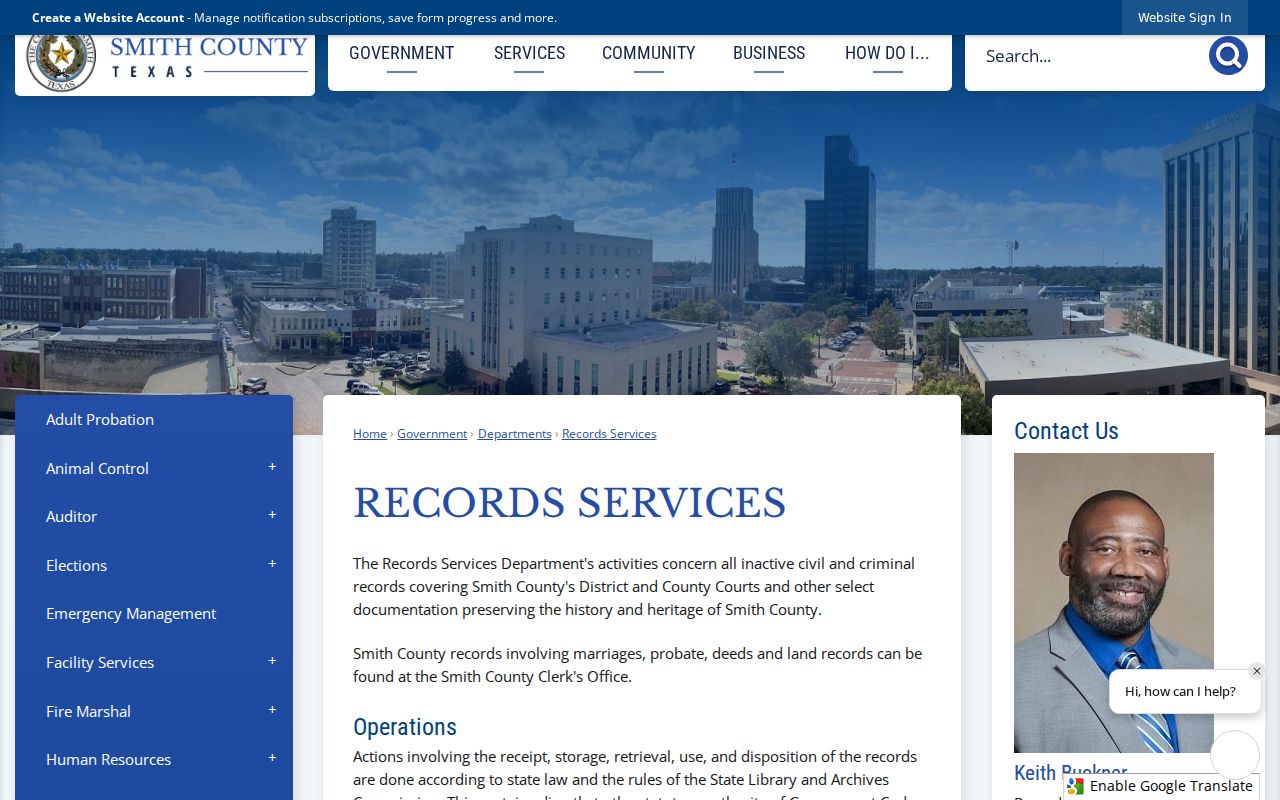
The archive route keeps an absent online result from becoming a false claim that no older case exists.
Smith County Criminal Records: What They Contain
A Texas CCH entry can carry more detail than a conviction list. The person segment may show state and FBI identifiers. An arrest cycle can include a TRN, arrest date, arrest name, agency case number, arresting agency code, offense date, statutory charge, degree, and arrest disposition. Prosecution and court segments can then add the filed offense, action dates, court and cause number, final plea, disposition, sentence, confinement, probation, fines, appeal data, and custody destination.
The Smith County court file is the better source for the local docket and final judgment. A jail record is the better source for a booking event and time-sensitive custody state. Public DPS data is the better source for the statewide subset Texas allows by name. Match each field to its source and date before drawing a conclusion.
| Name and identifiers | Recorded names, SID, FBI number, TRN, TRS, ORI, and local cause or booking numbers. |
|---|---|
| Arrest and booking | Dates, agency, alleged offense, intake, bond, custody, and release information where public. |
| Court charge | Filed wording, statute, class or degree, prosecutor action, and docket events. |
| Disposition | Conviction, dismissal, acquittal, transfer, deferred result, or another recorded outcome. |
| Sentence | Confinement, community supervision, fine, costs, and concurrent or consecutive treatment. |
| Supervision | Probation, custody agency, prison status, and parole dates when lawfully reported. |
Smith County Court Record Clerks
Felony records belong to the Smith County District Clerk at 100 North Broadway, Room 204, Tyler, Texas 75702. The main published number is 903-590-1660, with felony information at 903-590-1670 and record requests at 903-590-1674. The office is open weekdays from 8 a.m. to 5 p.m.; payments stop at 4:30 p.m. Regular emailed copies are $1 per page through fifteen pages, then $15 per document at sixteen pages or more.
Class A and B misdemeanor files belong to the County Clerk Criminal Division at 200 East Ferguson Street, third floor, Tyler, Texas 75702. Its number is 903-590-4680, and copy requests may go to crimcopies@smith-county.com. The local misdemeanor background search is listed at $5, with printed pages at $1 each. City and justice courts keep the fine-only cases within their own jurisdiction, so the issuing court name on a citation or warrant matters.
District Clerk
100 N. Broadway, Room 204
Tyler, TX 75702
903-590-1660
Weekdays, 8 a.m.-5 p.m.
County Clerk Criminal Division
200 E. Ferguson, third floor
Tyler, TX 75702
903-590-4680
Weekdays, 8 a.m.-5 p.m.
Records Services
1517 W. Front, Room 150
Tyler, TX 75702
903-590-2960
Closed noon-1 p.m.
Texas Public Access Laws
The Texas Public Information Act, Government Code Chapter 552, governs many records held by state and local agencies. Judicial records are different. Government Code Section 552.003 excludes the judiciary from the ordinary PIA route, so court files follow court rules, clerk statutes, and the proper clerk's copy process. That is why a county public-information form should not replace a District Clerk or County Clerk request for a case file.
Criminal-history dissemination has its own limits. Chapter 411 keeps DPS-maintained criminal-history record information confidential except where the law authorizes release. Section 411.135 creates the public conviction and deferred-adjudication search. Active-investigation details, juvenile law-enforcement records, victim identifiers, and other protected facts may be redacted or withheld under separate laws.
Key Texas laws:
Government Code Chapter 552 sets public-information rights, production duties, charges, estimates, and law-enforcement exceptions.
Government Code Chapter 411 controls access to DPS criminal-history information and nondisclosure effects.
Code of Criminal Procedure Chapter 62 governs sex-offender registration and public registry information.
Code of Criminal Procedure Chapter 55A sets Texas expunction procedures and eligibility paths.
The DPS Crime Records Division hub connects the repository's official services.
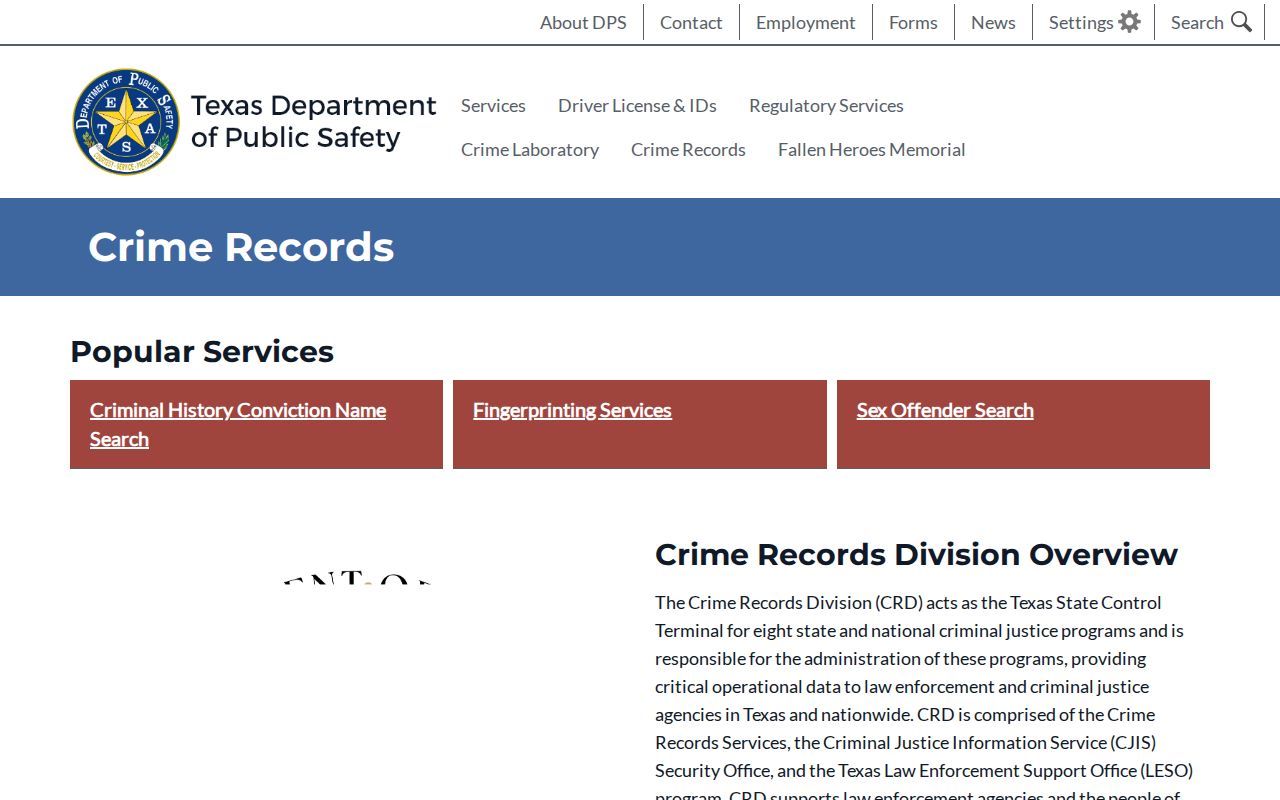
The hub separates public name searches, personal reviews, and other state record services.
Smith County Record Request Routes
Send a request to the office that created or holds the record. The sheriff or jail handles sheriff incident, arrest, and booking material. A city police department handles its own report. Clerks handle judicial files. Smith County's electronic Public Information Request form is the broad county fallback, and requests may also follow an office's published mail, fax, email, or in-person procedure. Describe the date range, agency, record type, location, and report, booking, or case number when known.
A government office does not have to answer a research question or create a new record. When an Attorney General decision is needed, Section 552.301 generally gives the office ten business days to request that ruling; it does not guarantee that every file will arrive in ten days. Smith County says it will provide a reasonable production date in writing when it cannot produce the information within ten working days. An itemized estimate may be issued above $40.
The county public-information page explains the request choices and cost process.
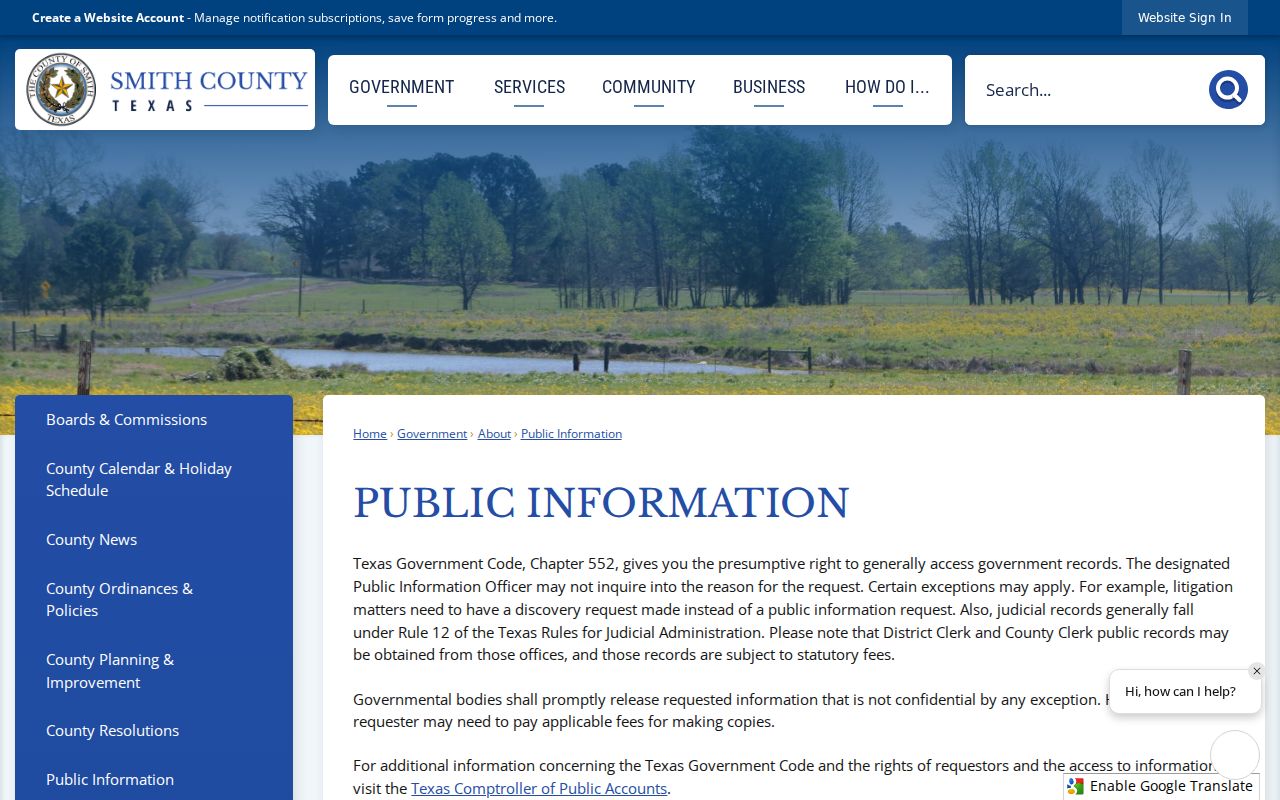
Judicial files still route to the clerks even though the county form is useful for many executive-agency records.
Restricted, Sealed & Expunged Records
Texas now places expunction law in Code of Criminal Procedure Chapter 55A. Eligibility depends on the event and the exact statute. Acquittals, pardons, mistaken identity, and some dismissals after waiting or limitation periods have distinct paths. Time alone does not erase a conviction. A person generally files in the court selected by law, identifies every record custodian, pays current filing and service costs or submits an inability-to-pay statement, and follows the required notice and hearing process.
An order of nondisclosure under Government Code Chapter 411, Subchapter E-1 is different. It restricts public dissemination while keeping access for listed government and authorized entities. Juvenile law-enforcement records have their own restrictions under Family Code Section 58.008. A missing portal result can also reflect sealing, data coverage, spelling, or delay, so it should not be treated as proof that a record was destroyed.
Note: Court staff can explain filing steps, but only legal counsel can assess how Chapter 55A applies to a specific history.
Smith County Expunction Record List
A 2025 law change led the District Clerk to publish a local recipient list in April 2026 under Code of Criminal Procedure Section 55A.253(c). The list identifies the Office of Court Administration, DPS for its own records and FBI, NCIC, and TCIC routing, the Smith County Sheriff's Office, Smith County Jail, and the Criminal District Attorney. It is a practical local aid for naming the agencies that may hold pieces of an arrest and prosecution cycle.
The District Clerk also warns that its list may not be complete or apply to every petition. That warning matters. A city police department, separate jail, prosecutor, clerk, or other agency may have created or received a record in a given case. Gather the arrest date, charge, arresting agency, TRN, cause number, and court before filing, and check the current clerk instructions rather than copying another person's recipient list.
City-by-City Criminal Records in Smith County
Tyler, Lindale, and Whitehouse each have a police department and municipal court, so a city-created report or fine-only case may never begin at a county clerk's counter. A custodial arrest can still lead to Smith County Jail, and a Class A, Class B, or felony filing moves into the county court system in Tyler. Use the agency and court named on the report, citation, or booking entry instead of relying on the postal city alone.
These city pages keep local request routes at city level and send countywide custody or higher charges to the right Smith County source.
Tyler Record Check
Tyler Police reports, municipal fine-only cases, and county routing from the county seat.
Lindale Record Check
Lindale Police and Municipal Court records, with jail and higher filings routed to Tyler.
Whitehouse Record Check
Whitehouse city reports and citations, plus the Smith County booking and court trail.
Smith County Custody Record Routes
Use Smith County Jail Search for recent and pretrial custody, then call the jail or sheriff if the portal fails or a transfer may have occurred. The county's budget materials list 1,139 beds across Central Jail, Low/Medium Risk, and courthouse capacity. They also record 7,042 book-ins in 2024, down from 7,847 in 2023. A book-in is an event, not a conviction or always a unique person, and overflow contracts can place a Smith County detainee in another county.
After a state-prison transfer, use the TDCJ Online Inmate Search. Federal custody uses the Bureau of Prisons locator. Probation starts with the judgment and Smith County CSCD, while parole status may require TDCJ or the Board of Pardons and Paroles. A March 2026 sheriff alert also warned that scammers used real custody details to demand false bond or monitor payments by cryptocurrency and payment apps. Official law enforcement does not call to demand that payment.
The Smith County Adult Probation page provides the local supervision office details.
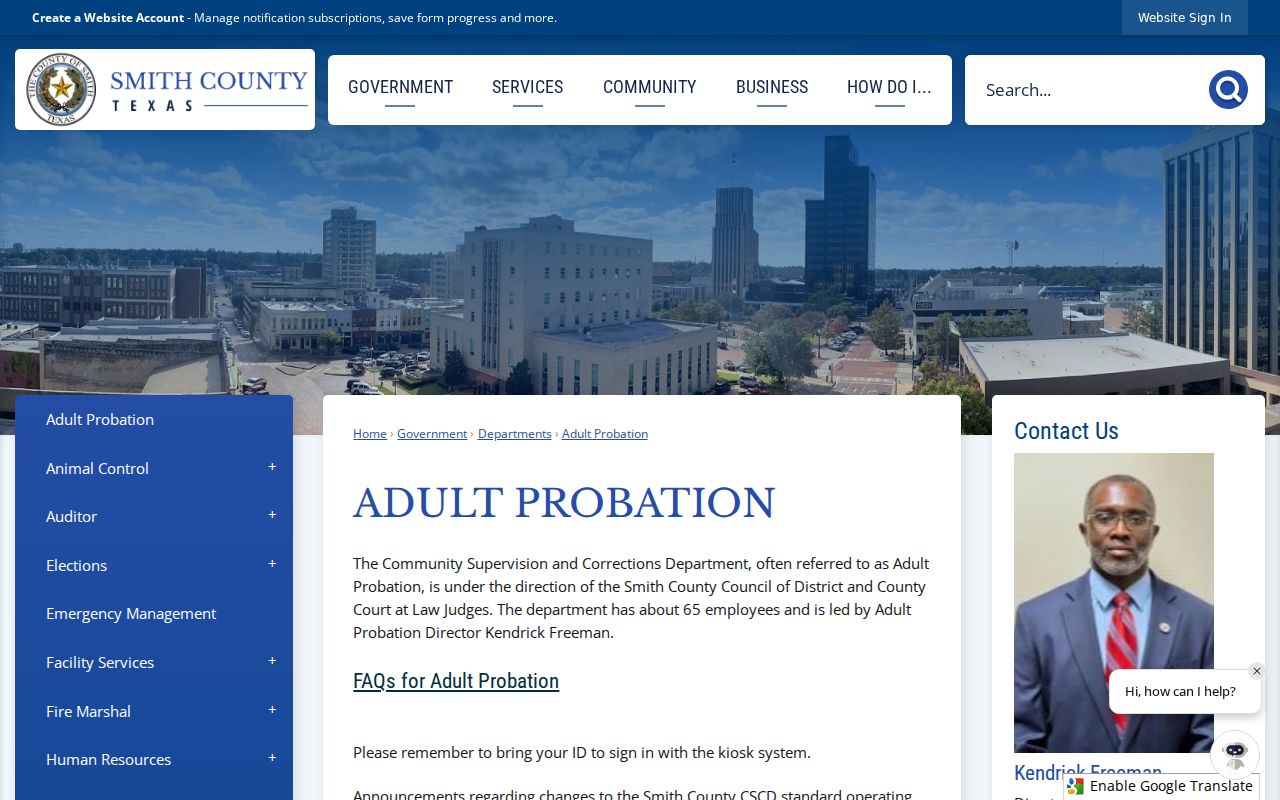
Court dockets may show that supervision was imposed, while internal plans and risk notes should not be assumed public.
Smith County Court Record Transition
The operating courthouse dates to 1955, and Smith County is building a replacement expected near the end of 2026. Official plans show separate paths and elevators for the public, judges and staff, and people in custody, plus holding cells near courtrooms and a secure tunnel to the jail. Those security choices explain why a court counter and a jail record remain distinct even when the buildings sit close together.
Until Smith County announces a move, use each office's current published address. Construction can change parking, entrances, and temporary routes before the law or custodian changes. The District Clerk remains the felony-record keeper, the County Clerk retains Class A and B misdemeanor files, and Records Services handles older inactive holdings. Recheck the official department page before visiting, especially late in the transition.
The DPS public search interface remains a separate statewide route during local construction.
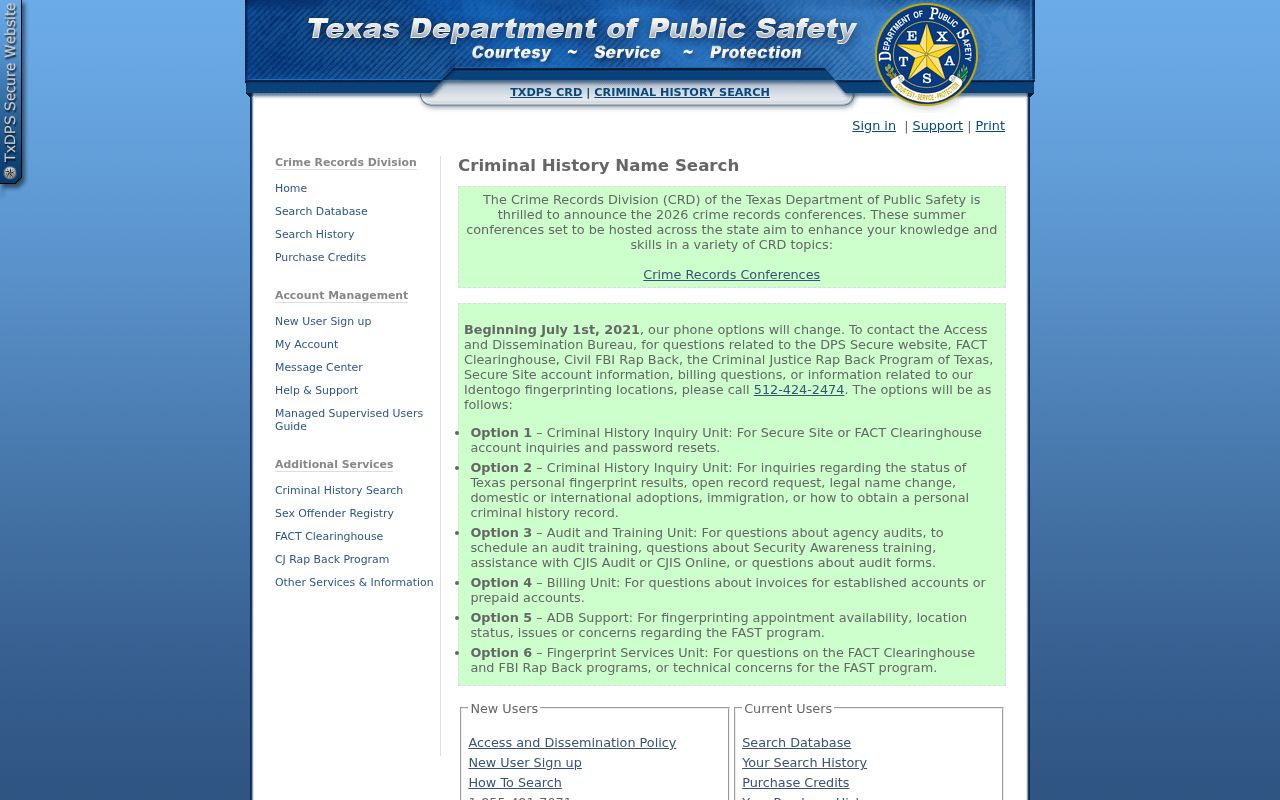
A local building move will not turn that statewide public product into a complete Smith County case index.