
Criminal Court Cases in Smith County
Smith County criminal cases are divided by charge level and place. The District Clerk keeps felony files for the District Courts. Local criminal jurisdiction includes the 7th, 114th, 241st, and newer 475th District Courts as assigned, while the 321st District Court is designated for family law. The County Clerk's Criminal Division keeps Class A and Class B misdemeanor files heard by the County Courts at Law. A fine-only Class C matter may instead remain with a municipal court or the justice court for the proper precinct.
The clerk is the custodian even when a judge, prosecutor, jail, or police agency also has information tied to the event. The case file is the best source for charges as filed, pleas, motions, settings, disposition, and sentence. A jail entry is only a custody snapshot. For a visual point of reference, the county's District Courts page identifies the local trial-court structure.
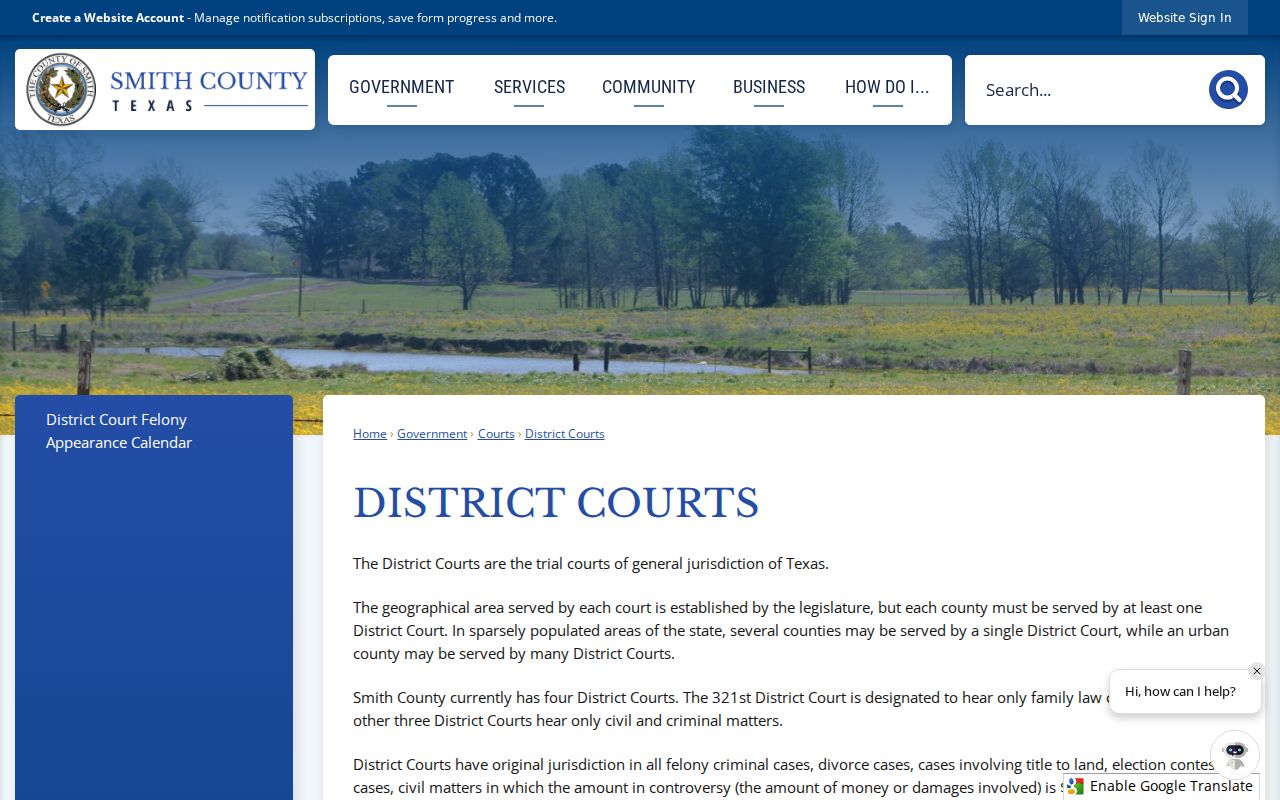
The Smith County court listing helps a searcher distinguish the tribunal hearing a case from the clerk that maintains its official record.
Smith County Court Portal Limits
The free Smith County Public Access portal is the practical first stop for local felony and misdemeanor leads. County materials report online criminal coverage from 1995 to the present. The portal can show index and docket data, but a result does not guarantee that each document image is free or available online. JavaScript, cookies, and a current browser may be needed. A same-name result is a candidate record, not proof of identity.
Smith County restored the Odyssey-based public site on October 21, 2024, after a weeks-long outage. During that interruption, clerks and jail staff supplied information through direct channels. That episode matters because it shows why a portal failure should not end a case search. Save the cause number and court when the portal works. If it does not, call the correct clerk or visit the counter rather than assuming the case is gone.
Note: A portal docket is useful for leads, but a certified judgment from the clerk is the stronger proof of a final result.
Smith County Case Record Searches
Search Smith County records with the most precise lawful identifier available. A cause number is stronger than a name. When only a name is known, use the full legal spelling and compare the court, filing date, charge text, and disposition before drawing a conclusion. Smith County indexes may reflect aliases, initials, or formats entered by different offices.
- Open Smith County Public Access and choose the Smith County criminal records area appropriate to the search.
- Try the cause number first. If it is unknown, search the party's full name and use other available filters to narrow candidates.
- Match the filing year, court, case type, and status. Do not merge two similar names into one history.
- Read each docket event in date order, then note the charging instrument, plea, judgment, sentence, and any appeal entry separately.
- Ask the District Clerk or County Clerk for a regular or certified copy when the document itself, not just index data, is needed.
The public interface was only partly captured during research, so no field below is described as universally required. Live labels can change.
| Search field | Input | Best use | Check against |
|---|---|---|---|
| Party name | Text | Finding candidate cases | Court, filing date, and charge |
| Cause number | Text | Opening one known file | Clerk and assigned court |
| Filing year | Date or filter | Narrowing common names | Docket filing date |
| Case type or court | Filter | Separating felony and misdemeanor records | Jurisdiction and clerk |
| Status | Filter | Finding pending or disposed files | Latest docket event and judgment |
Two Smith County Criminal Clerks
A felony record request goes to the Smith County District Clerk at 100 North Broadway, Room 204, Tyler, Texas 75702. The main number is 903-590-1660, with felony information at 903-590-1670 and record requests at 903-590-1674. Published hours are Monday through Friday, 8 a.m. to 5 p.m.; payment service stops at 4:30 p.m. The office lists emailed regular copies at $1 per page through 15 pages and $15 per document at 16 pages or more. Its page lists paper or certified copies at $1 per page, though a requester should confirm any certification add-on.
The official District Clerk source shows the office and its public-search route before a Smith County felony copy request.
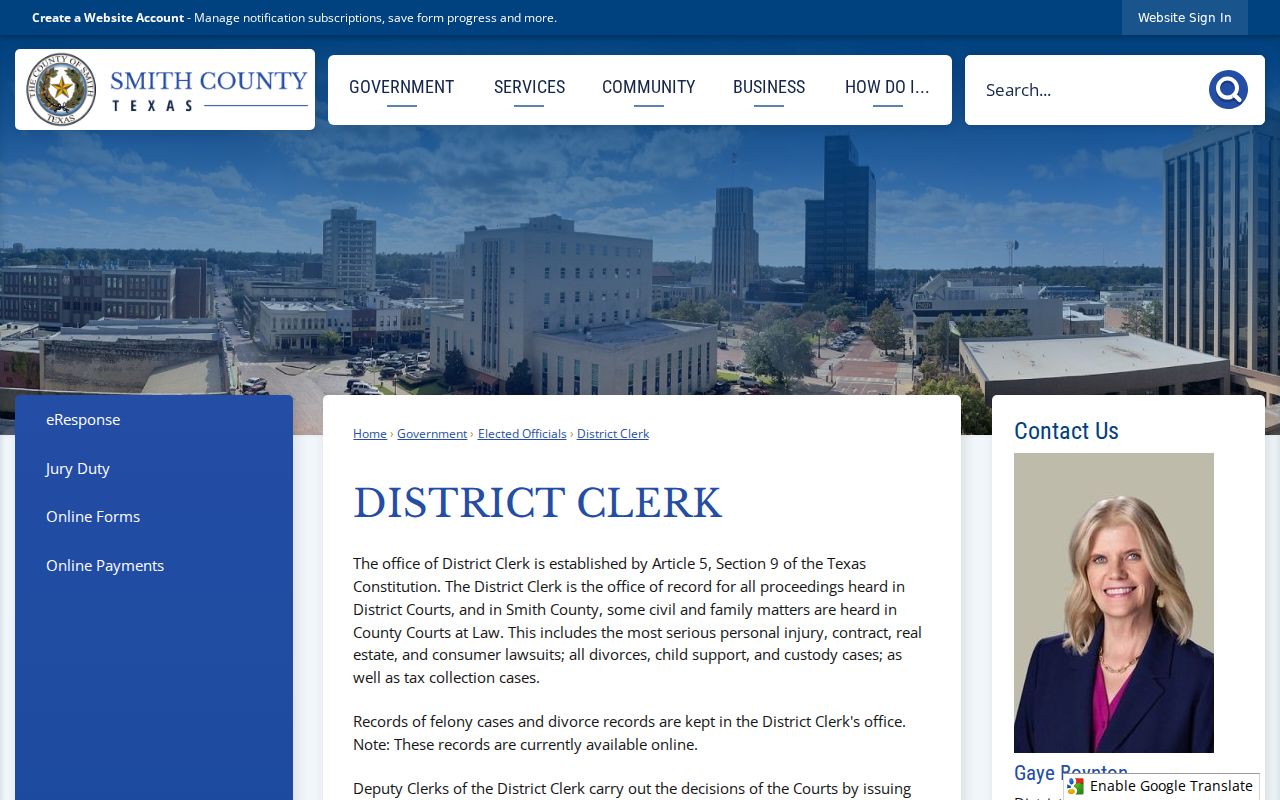
This source is the right route for indictments, felony docket sheets, judgments, and sentencing orders held in the district case file.
Class A and B misdemeanor records go to the Smith County Clerk Criminal Division at 200 East Ferguson Street, third floor, Tyler, Texas 75702. Its number is 903-590-4680, and published hours are Monday through Friday, 8 a.m. to 5 p.m. The office accepts copy inquiries at crimcopies@smith-county.com. Research found a $5 local misdemeanor background search charge and $1 per printed page. County Clerk criminal records reach back to 1976.
The County Clerk's official overview documents the separate misdemeanor role in the Smith County court system.
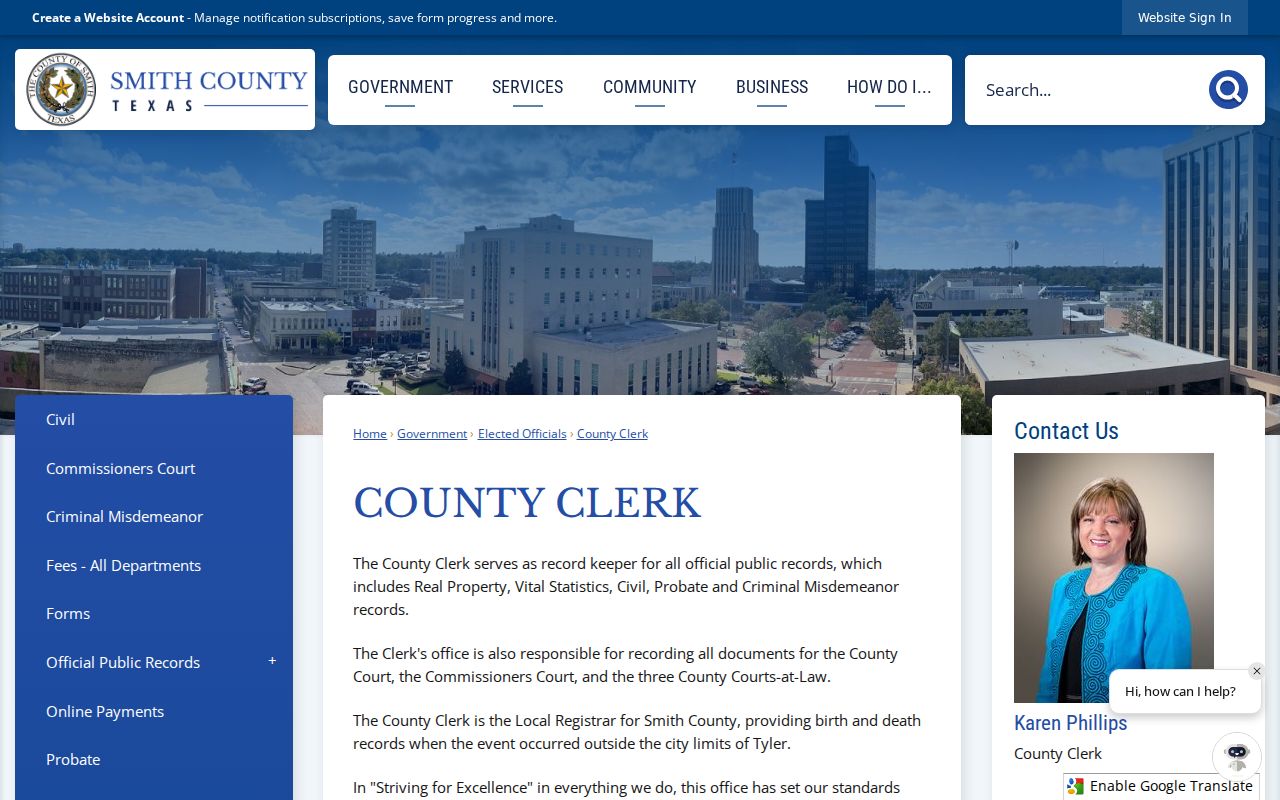
Keeping these clerk channels separate prevents a felony request from being sent to the misdemeanor records counter, or the reverse.
What a Criminal Case File Contains
A Smith County case file records the Smith County court process, not just the first accusation. It may contain the complaint, information, or indictment that states the filed charge; motions and settings that track pretrial work; a plea or trial result; a judgment; and a sentencing order. Some docket data is public even when a linked document is absent online. Sealed, confidential, juvenile, and protected victim material can be withheld or suppressed.
| Cause number and court | The local identifier and tribunal assigned to the filed Smith County matter. |
|---|---|
| Charging document | The complaint, information, or indictment stating what charge was actually filed. |
| Docket entries | Dated Smith County events for filings, settings, motions, pleas, capias activity, judgment, or revocation work. |
| Hearing details | The date, time, and court shown for a public setting, subject to later change. |
| Disposition and judgment | The recorded outcome, such as conviction, dismissal, acquittal, transfer, or another concluding action. |
| Sentence and conditions | Confinement, community supervision, fines, costs, and related terms when public. |
Bond data and a warrant or capias status may also appear. Those fields are time-sensitive. Confirm a current setting, active process, or balance with the office that controls it.
Read Smith County Case Status Carefully
Several short terms change the meaning of a Smith County court lookup. Pending means the portal shows no final recorded outcome. Disposed means the court recorded a concluding action, but that action is not always a conviction. It could be a dismissal, acquittal, transfer, or other result. Deferred adjudication follows a plea or finding and a period of supervision; it is not the same as a charge that was declined or dismissed.
- Cause number
- The identifier assigned to the court case, distinct from a jail booking number.
- Arraignment
- A court stage at which the accused is formally advised of the charge and a plea is addressed.
- Capias
- A court command for arrest issued after a case-related action.
- Disposition
- The court's recorded resolution of a charge or case.
- Judgment
- The signed court record that states the adjudication and, when applicable, the sentence.
A docket status is not a certified judgment. When the precise outcome matters for personal record review, obtain the judgment and compare it with any later appeal, revocation, or order affecting access.
Criminal Case Stages in Smith County
A Smith County criminal case begins in court when the proper charging paper is filed, which may occur after an arrest and booking. The prosecutor may file a charge that differs from the allegation listed at jail intake. The accused then reaches arraignment and pretrial work, where settings, motions, discovery, bond issues, and plea talks may create dated entries. A plea or trial leads to a disposition. If there is a conviction or deferred result, sentencing and supervision terms follow as the law and judgment require.
Case flow: Charges Filed → Arraignment → Pretrial → Plea or Trial → Disposition → Sentencing
The docket may also continue after judgment through an appeal or a motion to revoke or adjudicate community supervision. A filed motion is not itself proof that supervision was revoked. Read the later order before stating the result. Readers tracing events before the case was filed can compare the court record with the separate Smith County arrest search.
Older Smith County Court Records
An empty online search is weak proof when the expected Smith County case predates the portal's reported 1995 starting point. The County Clerk's misdemeanor holdings go back to 1976, and archived county material extends much farther through files, minute books, ledgers, and indexes. Inactive records are handled by Records Services in the Cotton Belt Building basement at 1517 West Front Street, Room 150, Tyler, Texas 75702.
Call 903-590-2960 or fax 903-590-2965 before a visit. Published hours are Monday through Friday, 8 a.m. to 5 p.m., with the office closed from noon to 1 p.m. Give the full name, approximate year, charge or court if known, and any old cause number. Genealogy and historical work often depends on these older indexes because spelling and numbering formats changed over time.
Note: Ask the active clerk first when age is uncertain, then use Records Services when the file has moved to inactive storage.
Access Rules for Case Records
Smith County judicial records do not follow the ordinary Smith County Public Information Act request route in the same way as county administrative records. Texas Government Code §552.003(1)(B) excludes the judiciary from that definition, so court records are obtained from the clerk under court rules and other law. A requester should ask the District Clerk, County Clerk, municipal clerk, or justice court that keeps the file. The general county public-information form is not a substitute for a judicial copy request.
Texas law also protects records and fields that are not open to general inspection. Family Code §58.008 restricts juvenile law-enforcement records. Victim identity protections, sealed cases, expunction orders under Code of Criminal Procedure Chapter 55A, and orders of nondisclosure under Government Code Chapter 411 can limit what appears. An online view may redact more than a clerk-held file that is available under controlled access, but no requester should assume protected content will be released.
Federal Cases Near Smith County
A federal criminal matter is not a Smith County District Court file or a Smith County prosecution. Smith County lies within the U.S. District Court for the Eastern District of Texas, and federal complaints, indictments, docket entries, orders, and judgments are searched through PACER after registration. A person held for federal proceedings may be housed under contract, so custody location alone does not turn the matter into a county prosecution.
The Eastern District's official site is the reliable route for current court and division contacts.
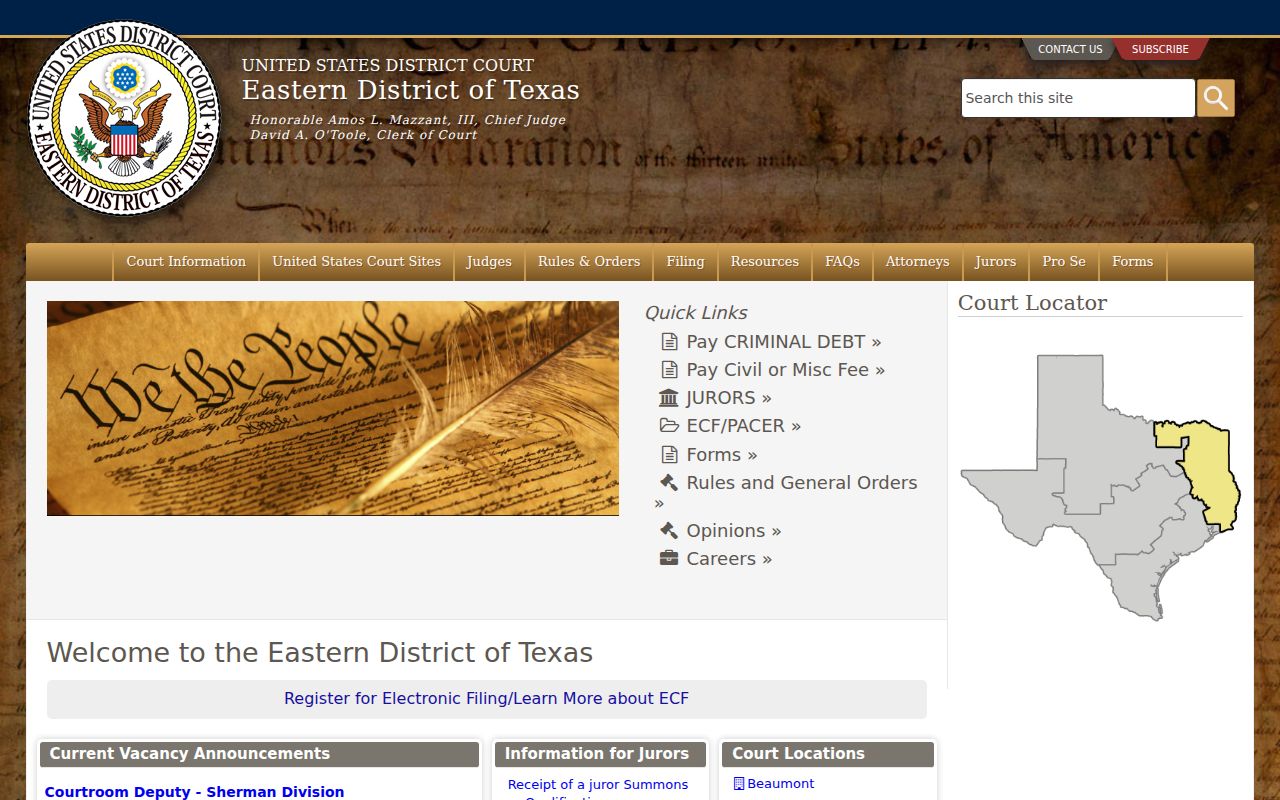
The federal source marks a clear boundary: PACER holds the federal docket, while Smith County clerks hold state felony and misdemeanor files filed locally.